
- contact@sunpro.com.sg
- 18 Kaki Bukit Road 3, #03-09 Entrepreneur Business Centre, Singapore 415978
Omnichannel POS Singapore (2026)
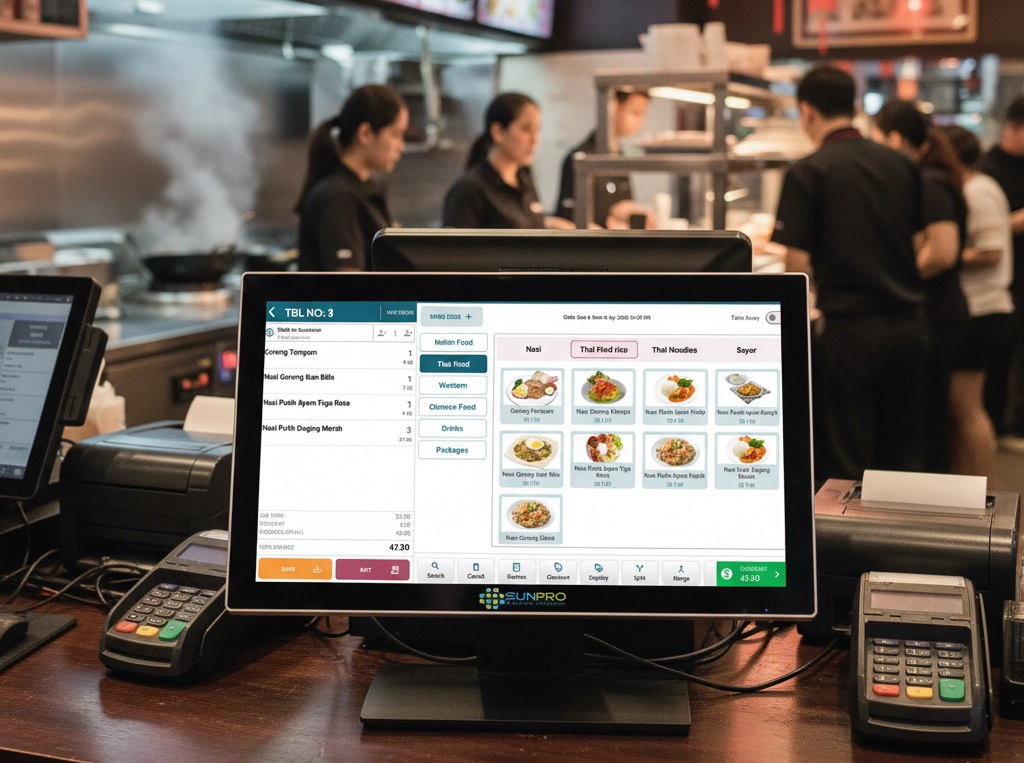
20
MAY
Omnichannel POS Singapore (2026) — Complete Buyer's Guide for F&B & Retail Operators
6+
Sales channels unified in one omnichannel POS Singapore platform
50%
PSG grant available for eligible Singapore SMEs
Singapore's F&B and retail landscape has fundamentally changed. A customer discovers your brand on Instagram, pre-orders on your website, picks up in-store via a QR kiosk, and leaves a Google review — all before your cashier has processed the next dine-in table. If your point-of-sale can't keep pace with every one of those touchpoints simultaneously, you're haemorrhaging revenue and customer data on a daily basis.
That's why omnichannel POS Singapore has become the most searched-for upgrade among forward-thinking F&B operators and multi-format retailers in 2026. This complete buyer's guide explains exactly what an omnichannel POS is, why Singapore-specific requirements matter (GST 9%, InvoiceNow, NETS, PayNow, GrabFood, PSG grant), how to evaluate systems, and how Sunpro Dine Connect's Omni-Channel POS — built by a Singapore company with 26+ years of local experience — delivers genuine unified commerce for Singapore operators.
What Is an Omnichannel POS Singapore?
An omnichannel POS Singapore is a unified point-of-sale platform that connects every sales channel — dine-in counter, takeaway, QR table ordering, self-service kiosk, branded online ordering, and third-party delivery aggregators like GrabFood and Foodpanda — into one single real-time system. Every order, regardless of where it originates, flows into the same kitchen display, the same inventory pool, and the same reporting dashboard.
This is fundamentally different from simply having a cloud POS and a separate delivery tablet. "Multichannel" means you have multiple channels. "Omnichannel" means those channels are unified — inventory is shared, customer loyalty points accumulate across all touchpoints, promotions fire consistently everywhere, and your accountant sees one set of numbers instead of five.
How Omnichannel POS Singapore Works
🍴 Dine-In POS
📱 QR Ordering
🍕 GrabFood / Foodpanda
💻 Online Ordering
🕳 Self-Order Kiosk
📞 Phone Orders
↓ All orders flow into ↓
Sunpro Dine Connect — One Unified Omnichannel POS Singapore Core
⏱ Kitchen Display (KDS)
📈 Real-Time Reports
🆕 Inventory Sync
🏅 Loyalty & CRM
💳 Unified Payments
📄 InvoiceNow / GST
In practice, this means when you 86 a dish at 7pm because stock ran out, that item disappears instantly from your dine-in menu, your GrabFood listing, your QR ordering page, and your kiosk screen — simultaneously, with zero manual intervention. That's the power of a true omnichannel POS Singapore.
Why Omnichannel POS Is Now Non-Negotiable for Singapore F&B
Four converging forces in the Singapore market have made omnichannel POS the operational baseline for 2026, not a premium upgrade:
1. Delivery Is Now 30–50% of Revenue — and Growing
GrabFood, Foodpanda, and Deliveroo together account for 30–50% of revenue at most Singapore casual-dining and QSR outlets. Managing three separate aggregator tablets means triple the chance of a wrong order, missed ticket, or out-of-stock embarrassment. An omnichannel POS Singapore consolidates all aggregator orders into one kitchen queue — no tablets, no missed orders, no awkward "sorry, that's sold out" calls to the customer.
2. QR Ordering Has Become the Default in Singapore
Since the post-pandemic shift, QR code table ordering has moved from novelty to expectation. Diners in Singapore now scan before a server even arrives. Without an omnichannel POS Singapore that natively integrates QR ordering into the same kitchen display and inventory pool as counter orders, you end up with separate systems that create kitchen confusion and stock discrepancies.
3. IRAS InvoiceNow Mandate Requires a Connected System
Singapore's phased InvoiceNow mandate requires GST-registered businesses to transmit invoice data to IRAS via the Peppol network. When you have five separate sales channels, each generating its own records, reconciliation and e-invoicing become an operational nightmare unless they all flow through one unified InvoiceNow-ready omnichannel POS Singapore platform.
4. Singapore Consumers Expect Seamless Loyalty Across Channels
A customer who earns loyalty points dining in expects those points to count when they order via the app. Without an omnichannel POS Singapore that has a unified customer database, your CRM is fragmented — and fragmented loyalty data means promotions that don't fire correctly and customers who feel unseen.
6 Sales Channels a True Omnichannel POS Singapore Must Unify
When evaluating any omnichannel POS Singapore vendor, confirm that all six of the following channels are genuinely unified — not just "compatible" via a manual export:
Channel 01
Dine-In POS
Counter and tableside ordering via iPad or terminal. The core channel that all others must sync with in real time.
Channel 02
QR Table Ordering
Customers scan to order directly from their phone. Orders land on the same KDS as counter orders — no separate queue.
Channel 03
Self-Order Kiosk
Standalone ordering screens that reduce cashier queues and upsell automatically via on-screen promotions.
Channel 04
Delivery Aggregators
GrabFood, Foodpanda, and Deliveroo orders all funnel into one kitchen queue. Menu 86s sync across all platforms instantly.
Channel 05
Branded Online Ordering
Your own website ordering system — no aggregator commission. Orders sync to the same POS and kitchen display.
Channel 06
Phone & WhatsApp Orders
Staff-entered phone orders route into the same omnichannel system — full inventory and reporting visibility.
10-Point Checklist: Evaluating Omnichannel POS Singapore Vendors
Not every platform using the word "omnichannel" delivers true unified commerce. Run every demo through this checklist before signing anything:
- Real-time inventory sync across all channels — Stock deductions must happen instantly when any order is placed on any channel. Test this during the demo: place a QR order and watch the counter stock update live.
- Single kitchen display for all channels — Every order — dine-in, QR, kiosk, GrabFood, online — must appear on one unified KDS screen. Multiple queues mean missed orders during peak service.
- Native GrabFood, Foodpanda, and Deliveroo integration — Direct API integration, not a third-party middleware that adds latency and a monthly fee. Menu updates and 86s must propagate in under 60 seconds.
- GST 9% compliance across all channels — Every receipt, regardless of channel, must generate a GST-compliant tax document. Reconciliation at month-end must be automatic, not a spreadsheet exercise.
- IRAS InvoiceNow / Peppol integration — Essential for GST-registered businesses. The InvoiceNow pipeline must cover all channels, not just counter transactions.
- NETS, NETS QR, PayNow, and credit card support — Native payment integration across every channel. QR ordering must accept PayNow. Kiosk must accept NETS and card. No third-party plugins.
- Unified loyalty CRM across all channels — Loyalty points must accumulate whether a customer orders via GrabFood, QR, kiosk, or counter. A unified customer profile is the foundation of omnichannel marketing.
- Centralised menu management — One menu update pushes to all channels simultaneously. Item names, prices, photos, modifiers, and availability must be manageable from one screen.
- Real-time consolidated reporting — One dashboard showing revenue, top sellers, and order counts broken down by channel. If you have to pull separate reports from GrabFood's partner portal and your POS, that's not omnichannel.
- Singapore-based support team — Omnichannel systems are complex. When something breaks during the Friday dinner rush, you need a local team who picks up the phone, not an overseas ticket queue with a 48-hour SLA.
Multichannel vs Omnichannel POS Singapore — What's the Difference?
This distinction is critical and frequently misrepresented by vendors. Here's the honest comparison:
✗ Multichannel (Siloed)
- Separate GrabFood, Foodpanda tablets
- Different menu versions across channels
- Stock deducted per-channel, not shared
- Loyalty points don't carry across channels
- Separate reports to reconcile monthly
- Manual 86 updates on each platform
- Multiple support contracts to manage
- Each channel invoiced separately for GST
✓ Omnichannel POS Singapore
- All aggregators in one KDS queue
- One menu synced to every channel
- Shared live inventory pool
- Unified loyalty CRM across all orders
- One consolidated dashboard
- Instant 86 propagates everywhere
- Single vendor for full stack
- Centralised GST and InvoiceNow
The Real Cost of Silos
Every Disconnected Channel Is a Hidden Cost Centre
Singapore F&B operators running five separate systems spend an estimated 8–12 hours per week on manual reconciliation, menu updates, and inter-system troubleshooting. At S$20/hour, that's up to S$960 per month in hidden labour cost — more than the monthly fee for a proper omnichannel POS Singapore. Factor in the lost revenue from mis-routed orders and out-of-stock disappointments, and the case for consolidation is overwhelming. Talk to us about a cost audit →
Sunpro Dine Connect Omni-Channel vs Generic Omnichannel POS Singapore
Many international platforms claim omnichannel capability but miss Singapore-critical integrations. Here's how Sunpro Dine Connect's Omni-Channel POS compares against typical alternatives in the Singapore market:
| Capability | Sunpro Dine Connect | Generic Omnichannel POS |
|---|---|---|
| GrabFood / Foodpanda Native API | ✔ Built-in | ✘ Third-party middleware |
| QR Table Ordering (same KDS) | ✔ Unified | ✘ Separate queue |
| Self-Ordering Kiosk Integration | ✔ Native | ✘ Paid add-on |
| Branded Online Ordering | ✔ Included | ✘ Extra subscription |
| Real-Time Shared Inventory | ✔ All channels | ✘ Partial / manual |
| NETS / NETS QR / PayNow | ✔ Native | ✘ Third-party only |
| GST 9% Compliance | ✔ All channels | ✔ Usually yes |
| IRAS InvoiceNow / Peppol | ✔ Native | ✘ Rarely |
| Unified Loyalty CRM | ✔ Cross-channel | ✘ In-store only |
| Xero / Accounting Sync | ✔ Built-in | ✘ Limited |
| Smart Boss Mobile App | ✔ Included | ✘ Not available |
| WhatsApp Order Integration | ✔ Native | ✘ Not available |
| PSG 50% Grant Eligible | ✔ Pre-approved | ✘ Varies |
| Singapore-Based Support | ✔ Local team | ✘ Overseas tickets |
How Omnichannel POS Singapore Pays for Itself
The ROI on a true omnichannel POS Singapore is faster than most operators expect. Here are the six savings levers that typically generate payback within 6–9 months:
- Eliminates Aggregator Tablet ChaosRunning three separate GrabFood, Foodpanda, and Deliveroo tablets costs at least one staff member's partial attention full-time during service. Unifying all orders into the KDS typically frees 1–2 hours of labour per day per outlet.
- Cuts Menu Management Time by 80%Updating a seasonal menu across five separate platforms currently takes 2–4 hours per update cycle. With an omnichannel POS Singapore, one update propagates everywhere in minutes. That's a meaningful saving for any multi-format operator.
- Reduces Wrong Orders and ReprintsKitchen errors from manually re-entering delivery orders onto paper tickets typically cost 1–3% of delivery revenue in wasted food and customer refunds. A unified KDS eliminates this category entirely.
- Real-Time 86 Prevents Customer DisappointmentAn out-of-stock item that stays live on GrabFood generates a cancelled order, a refund, a bad review, and a lost customer. Instant cross-channel 86 from one omnichannel POS prevents every one of those outcomes.
- Loyalty CRM Drives Repeat VisitsUnified customer data across channels enables targeted promotions — "you haven't ordered in 2 weeks, here's 15% off your next order" — that are simply impossible with siloed systems. Repeat visit rate improvements of 10–20% are commonly reported.
- PSG Grant Covers Up to 50% of CostsFor eligible Singapore SMEs, the Productivity Solutions Grant cuts implementation costs in half. Sunpro is a pre-approved PSG vendor, which streamlines the application process significantly.
Which Singapore Business Formats Benefit Most from Omnichannel POS?
While any Singapore F&B or retail business gains from unifying its sales channels, these formats see the fastest and largest ROI from an omnichannel POS Singapore:
Multi-Outlet Chains
Centralised menu control, consolidated group-level reporting, and cross-outlet loyalty CRM from one platform.
Cloud & Dark Kitchens
100% delivery-dependent — omnichannel POS unifying GrabFood, Foodpanda, and own-website orders is their operational backbone.
QSR & Fast Casual
Kiosk + QR + counter + delivery all in one queue. Eliminate cashier bottlenecks without adding headcount.
Full-Service Restaurants
QR ordering, dine-in POS, and takeaway all synced. Waitstaff focus on hospitality, not tablet management.
Cafés & Grab-and-Go
High-volume QR + kiosk ordering with a unified loyalty programme keeps regulars engaged and returning.
Bubble Tea & Snack Brands
Kiosk surge handling + delivery integration + loyalty CRM — the full stack for modern queue-sensitive formats.
Explore every Dine Connect channel: Omni-Channel POS · QR Ordering · Self-Ordering Kiosk · Online Ordering · Loyalty & CRM · InvoiceNow
Claiming the PSG Grant for Omnichannel POS Singapore
Singapore SMEs can claim up to 50% of the qualifying cost of an omnichannel POS Singapore system under the Productivity Solutions Grant (PSG). Sunpro Inno Apps is a pre-approved PSG vendor, which means the government-qualification vetting has already been completed — you simply apply, reference our pre-approved solution listing, and claim.
Critical PSG rule: You must receive BGP approval before placing your purchase order. Signing a contract first and then applying forfeits the grant entirely. This is the most common and costly mistake Singapore SMEs make. Sunpro's team guides every eligible client through the full BGP application process. See PSG grant details →
PSG eligibility for omnichannel POS Singapore requires: registered and operating in Singapore; at least 30% local shareholding; meeting the group revenue / employment size criteria. Most F&B SMEs qualify without difficulty.
3 Mistakes Singapore Operators Make When Buying Omnichannel POS
After 26+ years working with Singapore F&B businesses, these are the three buying mistakes that cost operators the most time and money:
- Accepting "Compatible" as a Synonym for "Integrated"A vendor saying their POS is "compatible with GrabFood" may mean they support a manual CSV export once a day. Ask for a live demo of an order being placed on GrabFood and appearing on the kitchen screen in real time. If they can't demonstrate it in 60 seconds, it's not integrated.
- Underestimating the Loyalty CRM GapMany operators treat loyalty as a nice-to-have and sign an omnichannel POS without confirming that points accumulate across all channels. When customers discover their dine-in points don't count on their online orders, they churn. Confirm the CRM is truly unified before signing.
- Skipping the Peak-Service Stress TestAny system performs well during a calm weekday demo. Negotiate a 1–2 week live trial in your outlet covering at least two Friday dinner services. If the system slows down, misroutes orders, or loses connectivity during that period, you've found out before you're locked in.
Frequently Asked Questions — Omnichannel POS Singapore
Common questions from Singapore F&B and retail operators evaluating omnichannel POS Singapore solutions:
An omnichannel POS Singapore is a unified point-of-sale platform that connects every sales channel — dine-in, takeaway, QR ordering, self-service kiosk, branded online ordering, GrabFood, Foodpanda, and Deliveroo — into one real-time system. Inventory, pricing, promotions, and customer data are synchronised across all channels automatically, giving operators a single source of truth for their entire business.
A standard cloud POS handles in-store transactions via a tablet or terminal. An omnichannel POS Singapore goes further by unifying the in-store POS with online ordering, delivery aggregators, self-ordering kiosks, QR table ordering, and loyalty CRM into one connected platform — so menu changes, stock levels, and promotions update everywhere simultaneously with no manual syncing.
Yes. Qualifying omnichannel POS Singapore systems are eligible for up to 50% funding under the Productivity Solutions Grant (PSG). Eligible Singapore SMEs must apply through the Business Grants Portal before placing a purchase order. Sunpro Dine Connect is a pre-approved PSG vendor.
Yes. Reputable omnichannel POS Singapore providers generate GST 9% compliant receipts across all channels and integrate with the Peppol network for IRAS InvoiceNow e-invoicing — so every dine-in, delivery, and online order flows through the same compliant invoicing pipeline automatically.
Yes. A true omnichannel POS Singapore consolidates orders from all three delivery platforms into one unified kitchen display. Menu updates and 86'd items sync across all aggregators from a single dashboard, eliminating the chaos of managing three separate tablets during peak service.
Pricing for omnichannel POS Singapore typically ranges from S$150 to S$500 per outlet per month depending on the number of channels, terminals, and add-ons. After the 50% PSG grant for eligible SMEs, the effective cost can drop significantly — often lower than the combined cost of managing separate POS, online ordering, and delivery tools. Contact Sunpro for a personalised quote.
Ready to unify your channels?
Sunpro Dine Connect — Singapore's Most Complete Omnichannel POS Singapore Platform
Your customers don't think in channels. They think about your brand. Whether they're scanning a QR code at your table, ordering on GrabFood, or walking up to your kiosk, the experience should feel seamless — and so should the management on your end. Sunpro Dine Connect's omnichannel POS Singapore platform unifies all of it: one menu, one inventory, one dashboard, one loyalty CRM, one InvoiceNow pipeline. Built in Singapore for Singapore F&B, PSG-grant eligible, with a local support team that picks up the phone. Book your free Dine Connect demo →